

Analog Streaming

From Vinyl to Bit: The odyssey of digitalizing the sound of your turntable in real time.

It sounds like an absolute contradiction and, as a topic within the audiophile world, I know it generates a lot of doubts, rejection, and even hate. Is it possible to digitize a vinyl record without destroying its essence? Is it worth the effort? Should we keep the digital and analog worlds apart? Follow me on this crazy journey to find out.
The Origin of the Change: Seeking Maximum Transparency
Permit me a brief but necessary introduction. It all started a few months ago when, after changing my reference monitors to a pair of Axxess L1, I found myself with the perfect opportunity to turn the profile of the equipment I usually use for website reviews upside down. I went from classic Class AB amplification to the efficiency of Class D, and I replaced the preamplifier of a well-known brand with a solution designed under one obsession: the maximum transparency and channel separation possible.
I will not go into details yet about whether the change has been worth it or if, in purely listening terms, it is a better solution. The important thing is that now I have a highly transparent, resolutive system with a surgical clarity that serves as an ideal platform for evaluating equipment. That said, we can leave the Class AB vs. Class D debate for the comments later on.
The DSP Rabbit Hole
After implementing these new components and conducting the first listening tests, the opportunity arose to collaborate with Magic Beans Audio. This platform seeks to put into the hands of the average consumer the possibility of integrating DSP (Digital Signal Processing) into their equipment, using only a mobile phone (or computer) and a calibrated microphone (you can read the post dedicated to this at this link).
After falling headfirst into the rabbit hole that the implementation of a DSP represents, even with the ease and excellent results given to me by the Magic Beans Audio platform, an inevitable doubt assailed me:
"Okay, now my digital front end goes through a couple of convolution filters and upsampling in Roon but... what about the analog front end?"
If the DSP was the fall down the rabbit hole, the challenge of digitizing the signal from my turntable became the proverbial black hole. The obsession took root in me like few times before. I spent entire sleepless nights looking for options: software, A/D converters... In short, a nightmare? Perhaps not so much, but I would describe it as a true odyssey, with all due respect to Odysseus and Homer himself.
The First Link: In Search of the Ideal ADC
At first, the task seems simple: send the analog signal from the turntable to the computer, or to some device that converts it into ones and zeros, and with that, feed the almighty Roon. It seems easy. Well, it turns out it is not.
Since this was an experiment to see if it was possible and, without anticipating results, I started with the most logical task: looking for an ADC (Analog-to-Digital Converter). The options on the market are varied, not only in features and prices, but also in their ease of implementation.
To begin with, it must be taken into account that these devices are rarely designed with the traditional audiophile in mind. Their target audience is divided into two categories:
Streamers and podcasters: A constantly growing sector.
Audio and music professionals: A specialized technical niche.
I am referring, of course, to external audio interfaces. I completely ruled out internal options because the equipment dedicated to the audio setup is a MacBook and, logically, nothing fits inside there.
Focusing on features and costs, I realized that a higher resolution does not always dictate the price, but rather the brand and internal components have a greater influence. The features are similar across the spectrum, but depending on each brand and model we have slight variations, with the most commercial ones hovering around 24 bits and 192 kHz. Sufficient for our goal.
In the end, honoring my membership in the brotherhood of the closed fist (I'm a bit cheap), I opted for the second-hand market and acquired a Behringer U-PHORIA UMC202HD.

It was not just a decision born of cheapness; the Behringer offered me three key advantages:
XLR/Jack combo inputs: This allows me to take advantage of the balanced output of my current phono preamp, an iFi Zen Phono 2, using a custom-made cable that goes from the 4.4 mm balanced jack to a pair of 6.3 mm TRS connectors. The first link in the chain was covered with surprising quality at a minimal cost.
Native USB connection: It greatly facilitates communication with the computer. Its maximum resolution of 24 bits and 192 kHz is nothing to look down on. Although vinyl theoretically has an enormous extension, due to pure physical limits of the format, it would not be possible to exceed this digital capacity. Therefore, the alleged "loss of information" remains in the field of metaphysics and psychoacoustics, sciences with which I do not wish to fight today (or ever).
Headphone output: It is interesting to mention it, almost all the ADCs I evaluated for use have a headphone output. In some cases better or worse but, of course, it depends on the implementation. The Behringer has good sound although little power. It can work with my HD660S2, but these demand a lot from it. For use without great expectations, it is more than enough.
Having reached this point, the chain looks, more or less, like this:

The Real Headache: Integrating the Signal into Roon
With the equipment arranged and the cables connected, the physical part of the chain was ready. If we only wanted to capture the signal in digital format, with this and a simple software setup, we would be covered. However, here came the part that has caused me the most headaches, because I do not just want to capture the audio, but feed it into my Roon server.
Here, almost by accident, I discovered my new favorite feature of the platform: Pirate internet radio.
How Do We Make Roon "Listen" to Our Digitized Audio?
In practice, Roon is not designed to receive real-time audio inputs. Its primary function is to be a brain that processes digital audio from streaming services or local files. Fortunately, as the saying goes, "There is more than one way to skin a cat," and to solve this, several paths exist, though we will focus on two:
Creating a temporary playback file: Recording the vinyl in real time into a file that is generated the moment the needle drops, which is then captured by Roon in real time to be played back.
Broadcasting via local streaming: Capturing the audio from the ADC in real time and "broadcasting" it to a local URL address (HTTP), tricking Roon into tuning into it as if it were an internet radio station.
Since I am a total neophyte in real-time audio broadcasting, I managed to pull the task off based on stubbornness, patience, internet forums, and the invaluable help of AI tools to unstick code problems. After discarding the first option due to its excessive complexity and results that did not convince me, I dove headfirst into the local streaming route.
In the process, almost by accident, I discovered a very interesting universe populated by various radio stations that, outside of the application's official list, provide music lovers with music and streams of excellent quality, both in terms of fidelity and programming. We will surely talk about this on another occasion down the road.
The Software Required for Broadcasting
To make the computer act as a private radio station, I had to configure two essential tools:
Audio Hijack (by Rogue Amoeba): An excellent and very intuitive software that works through linked blocks. It captures the audio coming in from the Behringer interface and redirects it toward our streaming server. (Note: The free version introduces static noise after 10 minutes, but it is ideal for testing before checking out).
Icecast: A program that runs in the background and is responsible for generating the audio server itself.

Audio Hijack has turned out to be a very complete software, with an ease of use and features that are surprising. I highly recommend taking a look at Rogue Amoeba's software offerings; if you use a computer in your chain, I am 100% sure that one of their programs will bring tangible benefits to your audio listening.
For my part, I have already created several workflow profiles in Audio Hijack. Now I can backup my vinyl records into files in my music library, broadcast them live over the internet using the Icecast server, and utilize a few other features that we will discuss later on, such as applying a noise filter with just two clicks in real time to eliminate the annoying pops and clicks in the sound of some of our records.
If Audio Hijack already captures the audio signal, why is Icecast necessary? Because Roon is very strict with the URL formats it accepts in its "Live Radio" section. Just any link will not do, or you will run into an error.
Configuring Icecast was the most complex part, since it requires installing and managing it through the macOS Terminal using Unix commands, a territory where my technical knowledge evaporates. It was thanks to AI applications that I was able to find the necessary commands to make it work and, in a few minutes, everything was in order.
Heads up, this is important: you must make sure that ALL the equipment is working in the same configuration, in my case 24-bit/192 kHz, because otherwise transmission dropouts can occur. For Mac users, this means that Audio Hijack, Icecast (which receives its information from Audio Hijack), and the Audio MIDI Setup must be set to the exact same values. Otherwise, audio dropouts can occur. Ask me how I know...
The Verdict: Time to Lower the Needle
After synchronizing the services and checking that Roon recognized the local Icecast address as a valid station, the moment of truth arrived. I configured the address, Roon detected it, and it allowed me to edit a small icon and the name of the station; I kept it simple.

I placed Al Di Meola's Casino album on the platter as a test and lowered the needle. The signal traveled through the chain, was digitized, and reached Roon, which immediately applied the upsampling and convolution filters of my DSP in real time. One or two seconds after lowering the needle, the audio was playing through my system, with the perceptive filters and upsampling adjustments applied.
The result? It is the best the vinyl has sounded on my equipment in a very long time.
I know what the purists are thinking: the local broadcast goes through compression. However, those alleged losses fall completely outside the human hearing range. The advantages obtained by correcting the acoustic defects of the room using the DSP completely blow away any minimal degradation from the digitization process. The vinyl still maintains its warmth and dynamics, but now it sounds perfectly integrated and optimized for my listening environment.
Al Di Meola was followed by Joan Baez, John Coltrane, Ella Fitzgerald, and many more. With each vinyl, I rediscovered new textures and sounds that, thanks to the magnificent integration of my digital front end, became present with more authority than when the playback was confined to the analog world.
I must even admit that I enjoyed listening to some second-hand vinyl by applying the noise reduction filter, since there is always that track that has too many clicks and becomes impossible to enjoy. With Audio Hijack and the noise removal parameter, two clicks of the mouse were enough to eliminate them. Useful or not?
It is not a matter of higher or lower quality, but of balance and presentation. The integration of the digital world, represented by the application of the DSP, upsampling, and data transmission, had revitalized the sound of my system when listening to analog sources.
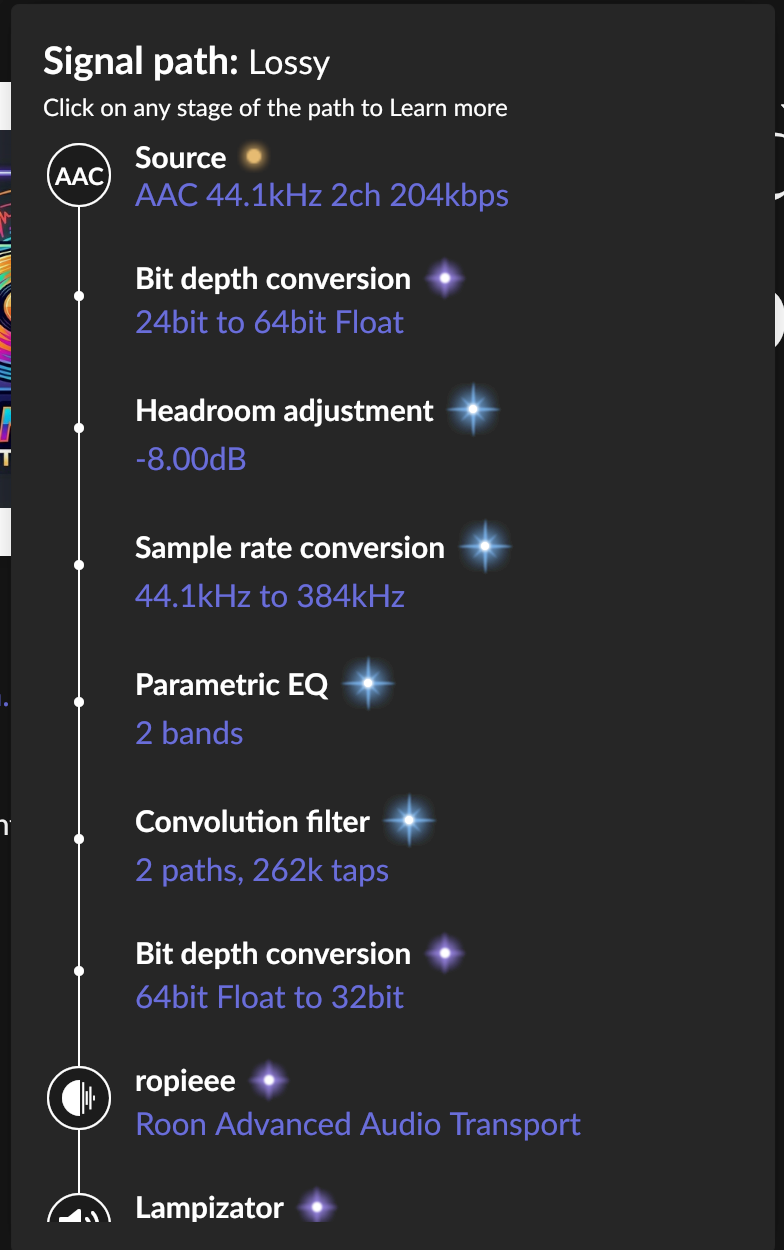
Roon shows the complete signal path and, although it appears as Lossy due to the codec (AAC - Advanced Audio Coding, which will be an old acquaintance for users of the iPod and other Apple products), the quality is nothing to look down on. We clearly see how correction and upsampling are applied to the signal, as well as parametric EQ and the DSP. For the entire signal, the result is surprisingly transparent, dynamic, and pleasant.
Yes, as I mentioned, it is possible to upgrade to .flac format (among others), but of course, let us not forget that we are still in the testing phase. This will come later.
Is the Hassle Worth It?
Having reached this point, the million-dollar question is mandatory: Is it really worth setting up this entire computer ecosystem just to listen to a vinyl record through Roon? To answer with total honesty, one must put the advantages and disadvantages on the scale. And, above all, be very realistic with our expectations.
Advantages
The magic of DSP in analog: Being able to apply room correction (convolution filters) and parametric equalization to the turntable signal changes the game. The acoustic defects of your room disappear, something that in a purely analog system would require thousands of euros in physical treatment or analog equalizers that usually degrade the signal.
On-demand upsampling: By passing the signal through Roon's audio engine, you can take advantage of digital upsampling to feed your components with a stable and optimized signal.
Audio throughout the house: By converting the vinyl into a local "radio station," you can group zones and listen to the record that is spinning in the living room from any other corner of the house that has a Roon endpoint. Or even through your phone with ARC; I call that flexibility.
Content backup: Yes, this is legal. If you own the record, you can create a digital backup of it, and not only that, digital tools exist that allow you to eliminate noise and clicks from the recordings.
Creation of a digital and flexible Line-In: Pay attention because, although I have focused on vinyl, we are capable of capturing the audio signal from any analog component. Can you imagine being able to play your tapes without having to rewind at every listen? Or even making backups of those mixtapes you used to listen to in the past?
Disadvantages
The lack of immediacy (Latency): The encoding process, transmission via Icecast, and the buffering that Roon does for safety introduce a delay of several seconds. Forget about lowering the needle and hearing the music instantly; there are a few seconds of silence until the music begins.
Technical complexity: It is not a plug-and-play system. It requires fighting with third-party software, configuring the Command Terminal on the computer, and accepting that if something fails in the local network, the music cuts off. C'est la vie, as the French would say.
The compression dilemma: If you use the free route or lossy codecs to facilitate real-time transmission, the most purist will throw their hands up in horror, claiming that a vinyl record is being "compressed." Although, in practice, the alleged losses turn out to be mostly inaudible. It is possible to generate a Lossless transmission chain, but the effort is considerably greater and the gains are marginal.
Equipment costs: Even the simplest configuration will require a small outlay. In my case, the cost has been around €100 for the ADC, the custom cable, and the software license. But it is easy to start multiplying costs if we do not opt for second-hand equipment or find ourselves attracted to those with higher performance.
In my case, I do not care about the latency. The moment of silence occurs only when starting the transmission and, after that, the music plays without interruption.
The technical complexity, on the other hand, is only initial because once the software has been downloaded and configured, the computer does the rest.
The compression dilemma is probably the biggest obstacle but, honestly, I have not noticed pronounced losses in terms of dynamics or detail. I will keep testing and, in case I notice them, I still have the option to increase the quality of the stream with a bit more technical effort.
Finally, the cost. €100 for the excellent software from Rogue Amoeba (which also covers some other needs, on which we will expand), the great flexibility my system has gained, and the learning I have acquired along the way seem to me like a good investment. I am even considering replacing the Behringer with a higher-performing unit in the near future, we will see. The replacement cable, for its part, is already at home: the iFi 4.4 mm to XLR. The goal is clear: bring the analog front end into the digital domain and, as a result, take advantage of the best of both worlds.
The Future of Roon: Will the Official Solution Arrive?
For those who see this entire process as an engineering aberration or simply as an unnecessary headache, there is light at the end of the tunnel. Roon Labs is fully aware that the integration of external sources and "Line-In" is one of the historic requests most desired by the audiophile community.
The company is already making moves on its roadmap with the development of Roon Ready Relay technology. The objective of this advancement is to allow external devices that feature an integrated ADC (like some modern phono preamps or streamers with a line input) to digitize and send that analog signal natively to the Roon ecosystem.
When this technology becomes completely standardized on the market, we will be able to manage the turntable within the Roon interface with the same fluidity, zone flexibility, and DSP management that we have today with a local FLAC file. But while that idyllic and simplified future fully unfolds, the brotherhood of the closed fist and computer enthusiasts will keep drawing on ingenuity, Unix code, and local radio servers to squeeze the most out of our phono cartridges.
Now then, we will surely still need the ADC, so why not get one now? It seems we have established that, beyond this exercise, which surely more than one person will qualify as absurd, it has other applications that can turn out to be equally or even more interesting.
I will keep reporting the progress on this little journey.


Comments