

Hidizs AP80 Pro Max
- Fernando Alday

- Jul 20
- 9 min read

A small DAP that impresses not only with its excellent sound, but also with an impressive array of features in a very small and attractive package.
Yes, I admit it. I belong (or rather belonged) to that group of people who thought that, with a smartphone, I had the issue of on-the-go listening completely sorted.
I must admit that I have overlooked some opportunities to test dedicated digital audio players (DAPs), focusing instead on reviewing portable DACs and other accessories for my out-of-home listening sessions. However, Hidizs' offer to provide me with their AP80 PRO MAX for a review has made me realize the potential that these dedicated players offer.
The segment of portable digital players with contained dimensions has found one of its most representative advocates in the firm Hidizs. With the AP80 Pro Max, the brand does not seek to compete in the league of the titanic Android-based DAPs that clog up pockets, but rather to offer a purist, compact, and highly versatile listening station. It is a device designed for the enthusiast who demands capable digital-to-analog conversion and precise driving on the move, becoming the ideal travel companion to squeeze the best out of direct analog transducers without the need to carry heavy additional modules.
Founded in 2009 by a group of engineers, musicians, and high-fidelity audio enthusiasts, Hidizs was born with a very clear purpose: to democratize portable high-resolution audio without implying paying prohibitive sums of money or carrying excessively bulky equipment. The brand was formally established after years of research and development, bursting strongly onto the international scene in 2014 with the launch of its first portable digital player (DAP), the Hidizs AP100. This device caught the attention of the audiophile community due to its remarkable conversion section and a highly competitive price.
From that moment on, the firm focused its efforts on space optimization and the pursuit of maximum energy and acoustic efficiency, becoming one of the key players in the boom of ultracompact players and pocket audio devices. Hidizs' philosophy is built upon three fundamental pillars: portability, timbral fidelity, and accessibility.
Unlike other brands in the sector that have evolved toward creating massive and heavy players, which often rival a large-format smartphone in size, Hidizs maintains that high-fidelity on the go must remain, above all, comfortable and lightweight. Their technical approach does not involve coloring the sound to make it artificially spectacular, but rather keeping a tonal profile as neutral and transparent as possible, allowing the user to decide the final character of the listening experience through the choice of headphones or via advanced and direct digital processing tools, such as the software environments they co-develop.
The Hidizs catalog has diversified over the years, covering practically every modern portable audio need through the following main lines:
Portable Digital Players (DAPs): Headed by iconic series such as the AP80 (in its different Pro and Max variants). They are the core of the brand, characterized by CNC-machined aluminum chassis, pocket dimensions, balanced outputs, and the use of dedicated Linux-based operating systems (like HiByOS) to prioritize acoustic performance over accessory functions.
Dongles and Portable DACs: With the popularization of smartphones without a physical headphone jack, the S9 series and the adapters from the XO and SD lines have become market benchmarks. They are small self-powered USB-C devices that elevate digital conversion to audiophile levels using ESS Sabre or Asahi Kasei chips with minimal battery consumption.
In-Ear Monitors (IEMs): The MS (Mermaid) series combines very meticulous aesthetic designs with hybrid transducer configurations (dynamic, balanced armature, and even planar-magnetic technology in their most recent models). They are tuned specifically to pair perfectly with the current delivery of their own players and dongles.
Construction and Design.
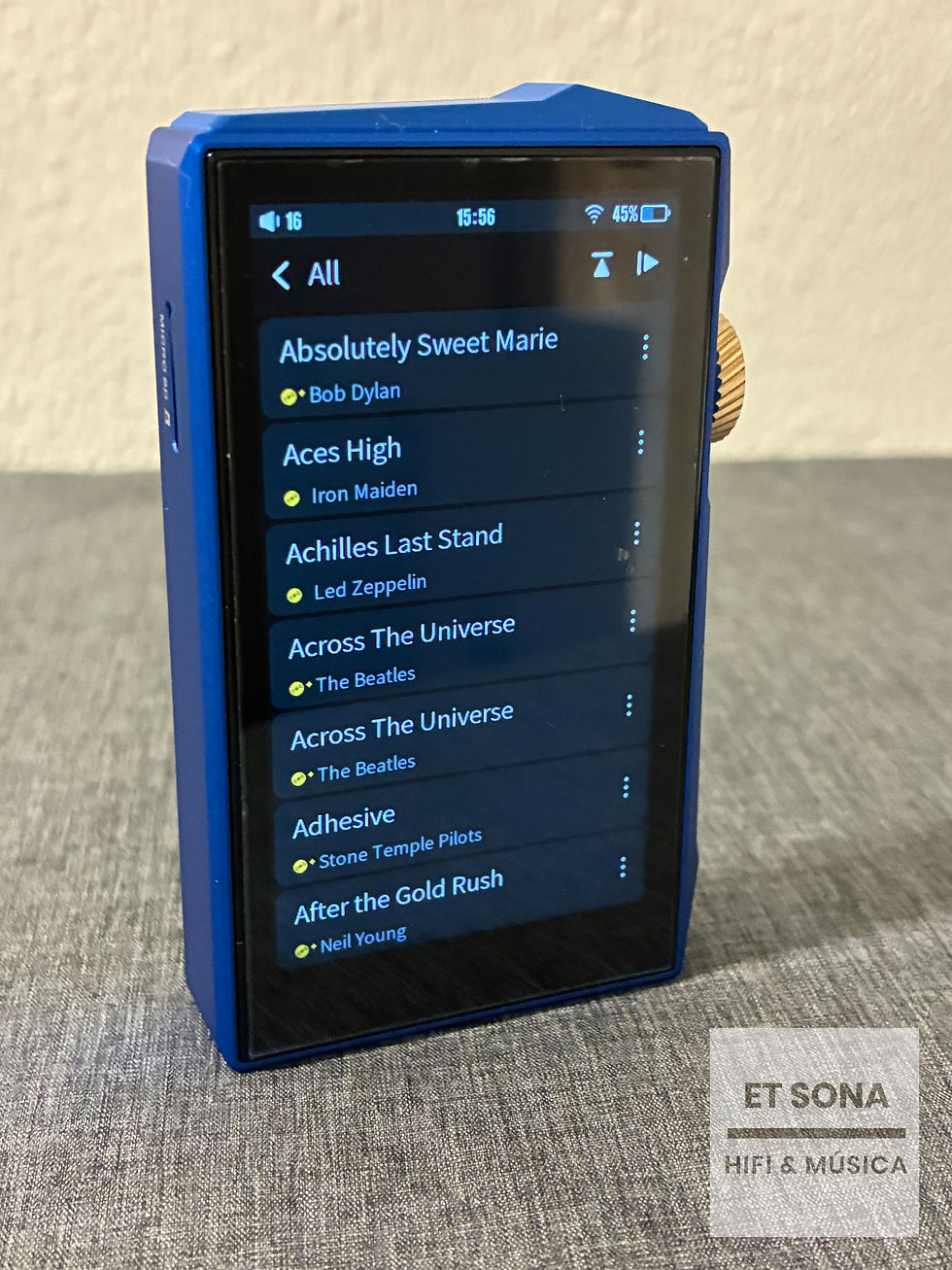
Physically, the AP80 Pro Max is a prodigy of portable ergonomics. The chassis, machined from a high-density aluminum alloy via CNC, exhibits very modern angular lines that facilitate grip despite its pocket dimensions. The front part is dominated by a high-quality touchscreen, which offers contrast and brightness levels more than sufficient for outdoor reading.

The silhouette, very refined in design, is flanked on the side by an analog volume wheel. This features a firm turn that also doubles as the power button. On the same side, an LED indicates device functions, surrounded by 3 dedicated buttons for playback.

At the base of the device, the physical connections are concentrated, highlighting a 3.5 mm Single Ended output and a 4.4 mm balanced output, a crucial addition for managing headphones with higher current demands. Additionally, there is the USB-C connection for charging and file management.

Internally, the dual-conversion architecture ensures an exceptionally low noise floor and optimal channel separation. In our test bench, the player was paired directly with the Simgot EP5 in-ear headphones and the fosi audio im4 monitors, two loads that allow a precise evaluation of current delivery, impedance control, and the timbral fidelity of the internal amplifier.
Believe me, its design speaks of a much higher cost than actual, but if you open the box and look at the AP80 PRO MAX and are still not surprised, you surely will be when you see the infinity of functions it offers. I will do my best to cover all of them.

The true backbone of the user experience on the AP80 Pro Max lies in its operating system: HiByOS. Unlike players that adopt heavy, open-source Android layers, Hidizs has entrusted its software architecture to the specialists at HiBy Music, achieving a perfect symbiosis between hardware and custom-written code. The result is a highly lightweight embedded Linux-based operating system that boots up in a matter of seconds and completely lacks the processing lag classic to multitasking systems.
Navigation through the touch interface is fluid and intuitive, structured specifically for managing local music libraries. The player indexes thousands of locally stored files at a surprising speed, meticulously respecting metadata and album art.
The jewel in the crown of HiByOS is, without a doubt, the MSEB (Mage Sound 8-Ball) sound adjustment system. Far from being a traditional graphic equalizer that introduces phase rotations and unwanted distortion, the MSEB acts as a parametric signal processor that allows modeling the sound based on practical audiophile concepts: overall temperature, bass extension, vocal texture, transient speed, and soundstage airiness.

It is almost like being able to apply DSP to your headphones in real time. This, without the cumbersome (and expensive) measurement equipment that such a process implies, or, failing that, the constant disappointments of applying canned EQs made by users with preferences different from our own.

The wireless and network versatility of the AP80 Pro Max is amazing for its size. In daily use, the AP80 has not stopped surprising me, even weeks after arriving.
Thanks to the HiByLink functionality (within the HiBy Connect suite), it is possible to link the player to a smartphone via Bluetooth to control local card playback from the comfort of a larger screen—a clever solution for when we carry the player away in a pocket. Does it seem complex to you? Don't worry, with UPnP connectivity, it is also possible to control the music passing through the AP80.

Additionally, the device can function as a bidirectional USB DAC, allowing improvement to the sound of a desktop computer or receiving a digital signal from a phone. Not only that, the quality in this mode is excellent, even surpassing some dedicated DACs that multiply its price several times over.
Special mention goes to its Wi-Fi connectivity, which not only facilitates music streaming but also allows configuring internet radio playback. In streaming mode, the ingenious operating system proves its worth, carrying out the functions of much more complex equipment with relative ease. We can search for content, browse playlists, and, in general, enjoy our network streaming services without any setbacks.
This connectivity also allows us to send music files to our DAP through a very well-executed web interface. Its simple, fast, and intuitive use seemed like one of the best parts to me. I have loaded hundreds and hundreds of files this way. All with 100% success, without dropouts and respecting the totality of the sent data.

On the other hand, and returning to the topic of internet radio, I must tell you that I found one of my favorite features. Configuring the streaming links of our cultural and jazz stations directly on the device via a text list opens an enormous range of possibilities outside the home, maintaining signal stability and benefiting from the same internal processing as local files—in terms of sound, no complaints at all. The excellent presentation, dynamics, and resolution of the AP80 have left me impacted.

The AP80 also offers multiple customization options beyond mere exterior color. We can choose wallpapers, operating system colors, etc. System navigation and response are excellent and easy to manage.
Although the AP80 Pro Max handles the IEMs from our test bench with ease and authority, we wanted to push the internal amplification section to the absolute limit of its physical capabilities. To do this, we attempted to directly connect the Sennheiser HD660S2 open-back over-ear headphones.
The result was as expected for a device of these dimensions: the integrated power section falls short against the demands of this transducer. Although the volume achieved might seem sufficient on paper, the sound loses its dynamic structure, the bass becomes fuzzy, and the soundstage visibly contracts due to the voltage demands of the Sennheiser's impedance.
To solve this bottleneck and strictly evaluate the conversion section of the Hidizs, we resorted to a dedicated external headphone amplifier, using the AP80 Pro Max as a pure source and line DAC. Through this external configuration, the HD660S2 completely revived, breaking down the music with absolute control, extended dynamics, and proving that the dual chip of the tiny player is a top-tier analog transport when exempted from heavy amplification duties.
With this configuration, 2 factors that the Hidizs handles smoothly are greatly appreciated. First, its reduced size, as it takes up no space and causes no inconvenience when placed next to other equipment, and second, the connectivity options that allow managing playback remotely. Thus, the AP80 Pro Max and amplifier combo stay in the pocket, while I manage playback from the iPhone without cuts or connection problems. And yes, with a sound substantially better than any Dongle DAC I have tested to date.
The Sound.
To put the AP80 Pro Max to the test, we structured the listening sessions alternating between FLAC files (24-bit) stored on the MicroSD memory card and high-resolution streaming services, ensuring a full evaluation of both transport methods. The internal amplification shows notable maturity, offering a balanced, honest sound signature with impeccable technical control:
Christian Scott aTunde Adjuah – "Twin" (Ancestral Recall): We started the test by playing a local FLAC file from the MicroSD connected to the 4.4 mm balanced output along with the fosi audio im4. The intricate blend of African percussions and Christian Scott's muted trumpet demands an immediate response speed. The AP80 Pro Max handles transients with astonishing ease; the impact of the drums is tight, physical, and does not muddy the midrange at all. The balanced output provides extra separation that allows pinpointing the movement of the drumsticks, demonstrating outstanding timbral maturity.
Samora Pinderhughes – "Grief" (GRIEF): We switched to high-resolution streaming and connected the Simgot EP5 to the 3.5 mm Single Ended output. This piece, of a breathtaking minimalism resting on piano and Pinderhughes' raw vocals, puts the circuit's noise floor to the test. The Hidizs offers a completely black background, free of unwanted electrical hiss. The voice projects forward with a flesh-and-bone texture and excellent timbral realism, while the piano exhibits a very natural harmonic decay that fades into silence, showing that the player respects the original micro-dynamics of the recording.
Alfa Mist – "4th Bridge" (Variables): We returned to the local library in FLAC using the external amplifier and a pair of Sennheisser HD660S2's to evaluate the handling of complex textures and snaking bass lines. The hip-hop and jazz foundation of this track comes in with magnificent authority and control. The AP80 Pro Max avoids the common tendency of compact players to bloat the low bass to fake more body; here, the electric bass is agile, deep, and maintains its well-defined space relative to the Rhodes chords and drum cymbals, confirming a professional-grade neutrality.
During the many weeks that the AP80 Pro Max has accompanied me, I do not stop being surprised by the quality of the sound emanating from it. Whether with open, closed headphones, or IEMs, the sound has weight, presence, detail, and excellent projection. I insist, it is hard to believe how good it is until you have heard it.
Technical Data.
Operating System: Linux-based HiByOS with MSEB processing and HiBy Connect connectivity suite (HiByLink).
Audio Outputs: 3.5 mm Single Ended (standard) and 4.4 mm Balanced.
Storage and Sources: Slot for MicroSD card (up to 2 TB) for local files (FLAC, DSD, WAV, etc.) and support for Streaming / Internet Radio via Wi-Fi.
Connectivity: Wi-Fi, bidirectional Bluetooth with LDAC and aptX support, USB-C (bidirectional DAC function).
Battery Life: Approximately 8 to 11 hours of continuous playback depending on the output and active wireless connectivity.
Conclusions.
The Hidizs AP80 Pro Max stands as an impeccable solution for the traveling audiophile who refuses to delegate their music to the compromised circuits of a generic smartphone. Its great success lies in adopting HiByOS as its nerve center; a lightweight, specialized operating system free from the distractions of conventional mobile platforms, which grants unparalleled sound adjustment versatility thanks to the MSEB engine and expands its boundaries with the inclusion of internet radio and the convenience of remote control via HiByLink.
Paired with direct and honest headphones like the Simgot EP5 or the fosi audio im4, the player proves that a heavy chassis or exorbitant budgets are not necessary to achieve a rigorous, detailed, high-fidelity sound with outstanding dynamics.
Hidizs has made an excellent selection of components and has executed what is, for me, a reference DAP in this (and many other) price ranges. For now, I admit it has become an inseparable companion during long listening sessions while traveling, when I am away from home, or even on some sleepless nights dedicated to discovering new artists and musical horizons.
Its logical limitations face complex loads, like the Sennheiser HD660S2, are elegantly resolved through external amplification, confirming that its digital conversion section is a highly mature piece of engineering that earns an absolute recommendation in the pages of Et Sona.
Gallery.
Hidizs AP80 Pro Max Hidizs AP80 Pro Max Hidizs AP80 Pro Max Hidizs AP80 Pro Max Hidizs AP80 Pro Max Hidizs AP80 Pro Max Hidizs AP80 Pro Max Hidizs AP80 Pro Max Hidizs AP80 Pro Max Hidizs AP80 Pro Max Hidizs AP80 Pro Max Hidizs AP80 Pro Max Hidizs AP80 Pro Max Hidizs AP80 Pro Max Hidizs AP80 Pro Max Hidizs AP80 Pro Max Hidizs AP80 Pro Max Hidizs AP80 Pro Max


Comments