

Fosi Audio BT20A MAX

One of the brand's most recent releases once again presents us with the question that has high-fidelity enthusiasts spinning. Can these amplifiers compete with traditional brands?
The Fosi Audio BT20A MAX represents the most ambitious evolution within the brand's compact amplification series. It is a design that condenses power, modern connectivity, and control into a reduced format, intended for desktop systems and 2.1 configurations with real high-fidelity aspirations. The approach is clear: to offer a high-efficiency amplifier with total speaker control, simple integration, and a technical level that transcends its size—not to mention high-fidelity sound and enough power to drive any speaker that crosses its path.
Has Fosi Audio achieved it? Let’s see...
Construction
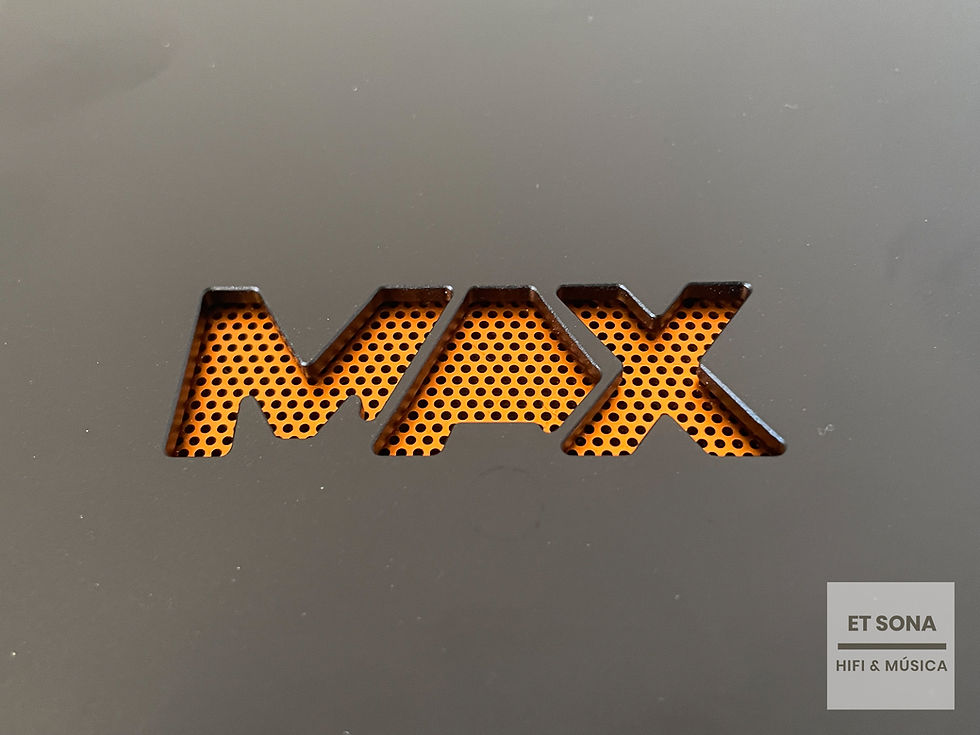
The BT20A MAX is presented in a compact chassis, like most of the brand's offerings. It is built from high-density metal with more than acceptable finishes. It features passive ventilation on both sides and on the top, with a nice detail that integrates the letters "MAX" into the chassis over a copper-colored metallic mesh background, a characteristic touch of the brand.

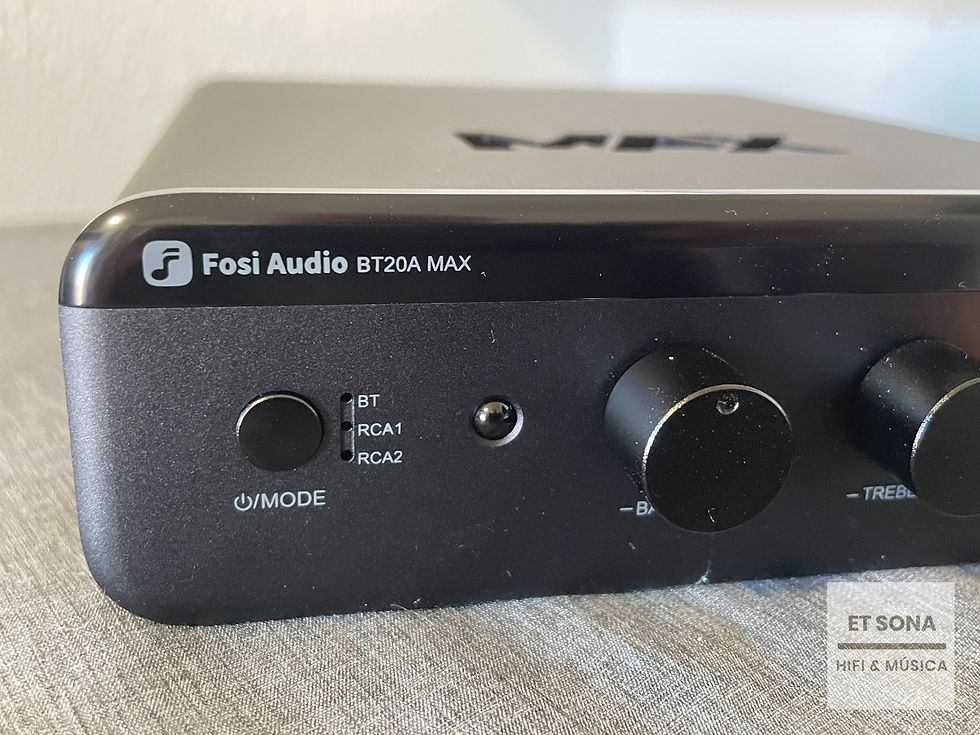
The layout of the controls on the front is straightforward: a motorized volume potentiometer, tone controls, an infrared receiver, and a multi-function button that allows you to power on the equipment and switch between the three possible sources (2 RCA and BT). Interaction is precise and fast, with an immediate response also from the remote control, which offers good range and ease of use, as it also integrates the possibility of working with other equipment from the brand.
On the back, you find connectivity typical of its format: dual RCA inputs, speaker outputs, and a dedicated subwoofer output. The inclusion of a high-pass filter (HPF) and a 12V trigger expands its integration into more complex systems. Let’s not forget, by the way, the Bluetooth connectivity, provided by a detachable antenna.

Inside, the core of the BT20A MAX is based on the Texas Instruments TPA3255 amplification chip accompanied by NE5532 op-amps—another opportunity for those of us who like to try new things. This combination is well known for its power delivery capability and linear behavior. There are not many surprises here.

However, the implementation of PFFB (Post-Filter Feedback) technology stands out, allowing the amplifier to maintain a consistent response regardless of the speaker load, while reducing distortion and improving linearity.
Back to the wireless section, the use of the Qualcomm QCC3095 chipset introduces Bluetooth 6.0 with support for high-resolution codecs such as LDAC and aptX Lossless, allowing for transmission up to 24-bit/96kHz. The declared power reaches 300W per channel at 4Ω, with an RMS delivery of 180W—figures that place the BT20A MAX in a very serious range within compact amplification.
How It Sounds
The choice of tracks moved through various emotional states in terms of listening. But before going into detail, let’s review what is currently accompanying the Fosi on the rack:
Power Treatment: Lampizator Silk
Turntable: Pro-ject Xpression 1 Carbon (acrylic platter, 8.6” Carbon Evo tonearm)
Cartridge: Sumiko Blue Point 3 Low MC
Phono Preamp: iFi Zen Phono 3
Phono Cables: Wires4Music Initio RCA
Power Cables: Bazco Audio L1 (custom), LessLoss C-MARC
Interconnect Cables: Final Touch Audio Thebe RCA
USB Cable: Final Touch Audio Callisto
Network Cable: BAZCO Audio L1 Ethernet
Streaming Platform: ROON/Qobuz
DAC: Lampizator Atlantic 5 TRP
Speakers: Axxess L1
Speaker Cables: Nordost Blue Heaven
Rack: Artesanía Audio Prestige 4 / Artesanía Audio Glass Turntable Rack
Accessories: Artesanía Audio Damper / Gutwire Ultimate Ground Cable
In all honesty, and without wanting to boast, it seems to me that this is an equipment setup that far exceeds a traditional pairing for the Fosi. However, I believe it will provide greater clarity regarding its virtues and possible defects, so let’s dive in.
Black Sabbath – Paranoid (2025 Remaster): Listening to the vinyl through the aforementioned playback chain, I must say the sound was presented with clarity and authority. Ozzy, Butler, Iommi, and Ward sounded incredible, and I enjoyed both vinyls in the edition—even the "Extra" tracks, which revealed a lot of detail. Ozzy’s characteristic voice had power, Iommi’s guitar possessed great energy, Geezer’s bass had plenty of depth, and Ward’s drums carried authority. I have no complaints here; it was a magnificent presentation.
Water No Get Enemy – Fela Kuti (Expensive Shit): Through ROON/Qobuz, I experienced a solid presentation with good depth in the orchestra. Kuti’s voice was powerful, and the projection had a very good profile. I liked the energetic presentation and the weight it carried. The Fosi undoubtedly has a lot of power and, once given space, it really stretches its legs at normal listening volumes. No distortion or loss of information was detected.
El Chinesco – Mariachi Los Camperos de Nati Cano: Some traditional Mexican music to end the session. Functionally, this is a small-format orchestral ensemble. The guitars, double basses, violins, and trumpets characteristic of mariachi fill the room with energy and a surprisingly well-textured recording with great depth and soundstage. The dynamic range of the recording and the detail of the instruments are well-preserved and exposed by the BT20A MAX. Once again, we hear authority in the bass, a good presentation in the midrange, and detail at the highest end of the register.
In summary, the character of the BT20A MAX is defined by control, energy, and clarity. The bass displays authority and structure. The current delivery of the TPA3255 translates into firm speaker control, with good extension and the ability to sustain high dynamics without losing definition. The midrange maintains transparency and tonal stability. Vocals and instruments are reproduced with good articulation, without noticeable dynamic compression even in demanding passages. Tonal coherence remains constant at different volume levels, except at low volumes, where the Fosi’s potentiometer shows a loss of information in the right channel.
This, I insist, occurs only at low volumes, but we have a problem here: if the user uses high-sensitivity speakers, they won't need much travel from the potentiometer to reach the desired listening volume. If this coincidentally falls within that zone, there will be a disparity in the power delivered to both channels. In practice, this translates to a loss of information in the right channel (silence) or a lack of balance between both channels (higher sound power on the left side). Consequently, it might seem like we have a problem when, in reality, it is a limitation of the component used. I am only pointing this out in case it happens to anyone. I do not consider it a problem beyond the case described.
Returning to the sound profile, the treble offers sufficient resolution and a clean presentation. The PFFB implementation contributes to a controlled delivery with good separation and an absence of grain. The soundstage is presented in an orderly fashion with correct separation between planes. The image maintains lateral stability with adequate depth for its category. The background is perceived as clean, favoring the reading of micro-details.
Technical Data
Class D amplifier based on TPA3255
Maximum power: 300W x2 @ 4Ω
RMS power: 180W x2 @ 4Ω
Signal-to-noise ratio: ≥112 dB
THD+N: ≤0.003%
Bluetooth 6.0 with LDAC, aptX Lossless, aptX HD, aptX Adaptive
Inputs: RCA x2, Bluetooth
Outputs: speakers, subwoofer
Integrated High-Pass Filter (HPF)
Remote control and motorized potentiometer
Dual power supply architecture for analog and digital sections
Conclusions
The BT20A MAX is designed as the core of a compact system. The combination of analog inputs and high-resolution Bluetooth allows for easy switching between sources. The remote control, motorized potentiometer, and bypass mode allow the amplifier's behavior to be adapted according to the system configuration. Subwoofer support and the integrated HPF filter facilitate the construction of balanced systems without the need for external processors.
The Fosi Audio BT20A MAX is a compact amplifier with a focus clearly oriented toward performance. Its combination of power, control, and modern connectivity positions it as a complete solution for desktop systems and simple stereo or 2.1 configurations.
The technical implementation, based on PFFB and a proven amplification platform, translates into stable, dynamic, and clean reproduction. Within its segment, it represents a solid, well-executed proposal with a level of performance that allows for the construction of very competent systems.
Does it equal a high-end amplifier? No, but for this price, I must say it gets quite close. Where do we find the main differences? In the presentation. Yes, the Fosi is very powerful and very transparent in terms of presentation. It provides great detail, acceptable separation, and good speaker control, but it lacks—in plain terms—the depth of presentation found in a high-end amplifier. To me, it seems to be a matter of current management rather than technical incompetence. The day Fosi decides to make a "Full Size" amplifier with reference-sized components and performance, more than one high-fidelity brand will have to start thinking about whether they want to stay in business. Progressively, every piece of equipment I hear from the brand shows substantial improvements.
Gallery.
Fosi Audio BT20A MAX Fosi Audio BT20A MAX Fosi Audio BT20A MAX Fosi Audio BT20A MAX Fosi Audio BT20A MAX Fosi Audio BT20A MAX Fosi Audio BT20A MAX Fosi Audio BT20A MAX Fosi Audio BT20A MAX Fosi Audio BT20A MAX


Comments