

LAiV Audio
- Fernando Alday

- May 11
- 7 min read
The Singaporean company offers us a look at its Harmony line, represented on this occasion by the DAC and its HP2A headphone amplifier. This review has been made possible through its distributor in Spain, Supersonido.

Few brands manage to create the impact that LAiV has achieved since its launch. Founded very recently (especially in terms of the audio world) in 2023, the firm has burst onto the scene with an aesthetic and technical maturity that seems typical of brands with decades of history.
Not only that. In a relatively short time, they have garnered the attention and respect of many users and audio critics, and fortunately, we have the opportunity to corroborate the positive comments we have seen so far throughout specialized audio forums and websites.
Contact with the Harmony series has been more than pleasant and, without a doubt, has left a very good impression on the writer of these lines. Allow me to share my experience with you.
Construction
I rarely stop to talk about product packaging but, on this occasion, I think I will make an exception and dedicate a few lines to it, as it is well worth it. I must say that unboxing the LAiV units has been a gratifying experience, which is increasingly rare in the world of high fidelity. Both devices come in a double box: a normal brown one on the outside, without decorations or branding, but upon opening it (clearly designed to protect the product during transport) we are greeted by a set of custom-cut foam and corner reinforcements. Secondly, a black box with top-level finishing and printing, as well as a design that surprised me. In this price range, at the very least, the experience of receiving your equipment and taking it out of the box should be as good as what LAiV offers.
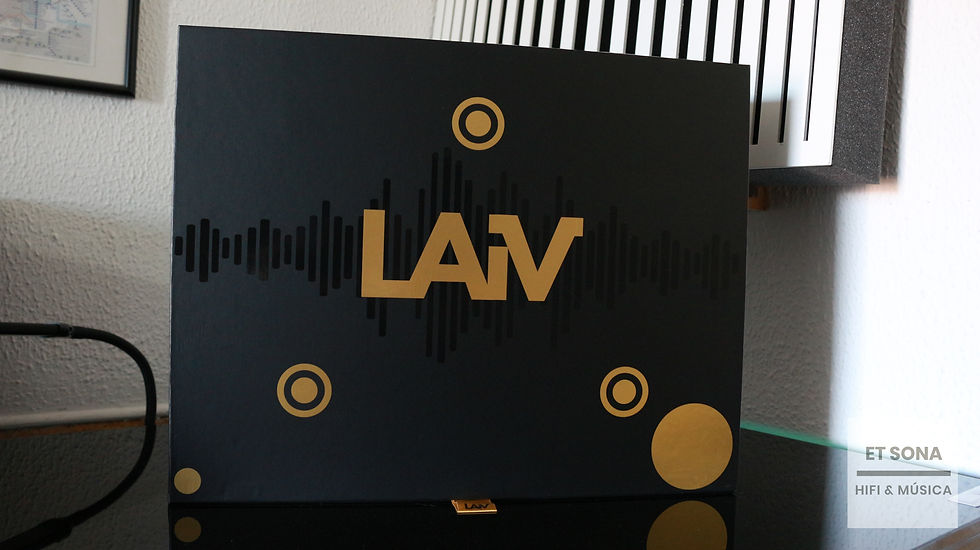
Since the equipment is new, we allow for a reasonable burn-in period, although from the very first moment, you can anticipate what will be heard. I like to let things run for a bit, primarily to check for any potential issues (very rare, but it has happened before). However, the LAiV units have performed excellently without any setbacks. I should mention that the HP2A reaches a certain temperature when operating for extended periods, but this is normal and should not worry you; that said, ensuring good ventilation is essential.

Physically, the chassis of both devices is a lesson in functional minimalism. The Harmony DAC and the HP2A share an identical footprint, allowing for perfect stacking that optimizes desk space. The front of the DAC stands out for its extremely sharp OLED screen and a control dial with a highly satisfying mechanical feel. For its part, the HP2A features a balanced internal architecture, something reflected on its back panel where the XLR inputs are the absolute protagonists. The robustness of the machined aluminum and the precision of the assemblies convey a sense of luxury and a finish that sits between modern and industrial which, in my opinion and in conjunction with its excellent performance, more than justifies its price. It is worth noting the weight of more than 4 kilos per unit, with the set reaching a total of 9 kilos.

On the front of the HP2A, we have three connection options for headphones: balanced 4.4mm and XLR, and single-ended 6.3mm. There is also a small selector knob that allows switching between the headphone output and the preamp function.
Both devices feature a set of monochromatic OLED displays, which are well-sized and offer excellent readability. The information provided to the user is complete and useful: on the DAC side, sampling frequency, file type, etc., and on the amplifier, the volume level, input source, and output mode (headphones or preamp). Extra points to LAiV for knowing how to integrate small-scale displays and making them useful, an area where many brands fail.

Regarding the connection options, on the back of the DAC, we find a power socket, a pair of binding posts for equipment grounding, and a set of digital inputs consisting of I2S, Coaxial, Optical, and USB. The device, remember, is balanced, so the XLR outputs are our best option, although LAiV has included a set of RCA connectors.
On the side of the HP2A amplifier, we have the same power and ground provision. There is a set of outputs (similarly balanced and Single Ended), provision for 12v Triggers, and a single Balanced XLR input. However, do not be discouraged by the fact that there is only one input, as the equipment features an LE-LINK connector. This allows connection to the LExt, an ingenious expansion system that offers the LAiV set user two options: a Phono version for integrating a turntable or a module with two additional inputs (1 XLR and 1 RCA). You can learn about the LExt here.

The accompanying equipment includes a David Laboga Akoya USB cable, as well as a pair of custom-made XLR jumpers crafted from pure silver wire (normally used for recording equipment and chosen for their short length) and my Arachne Audio XLR cable for the Sennheiser HD490 PRO PLUS. Power management has been handled by BAZCO Audio and their L1 cables, coupled with the Lampizator Silk. As you can see, it is a fairly contained setup and, in reality, the LAiV units, with their excellent space management system, stacked one on top of the other, barely take up the same footprint as the laptop on my desk.
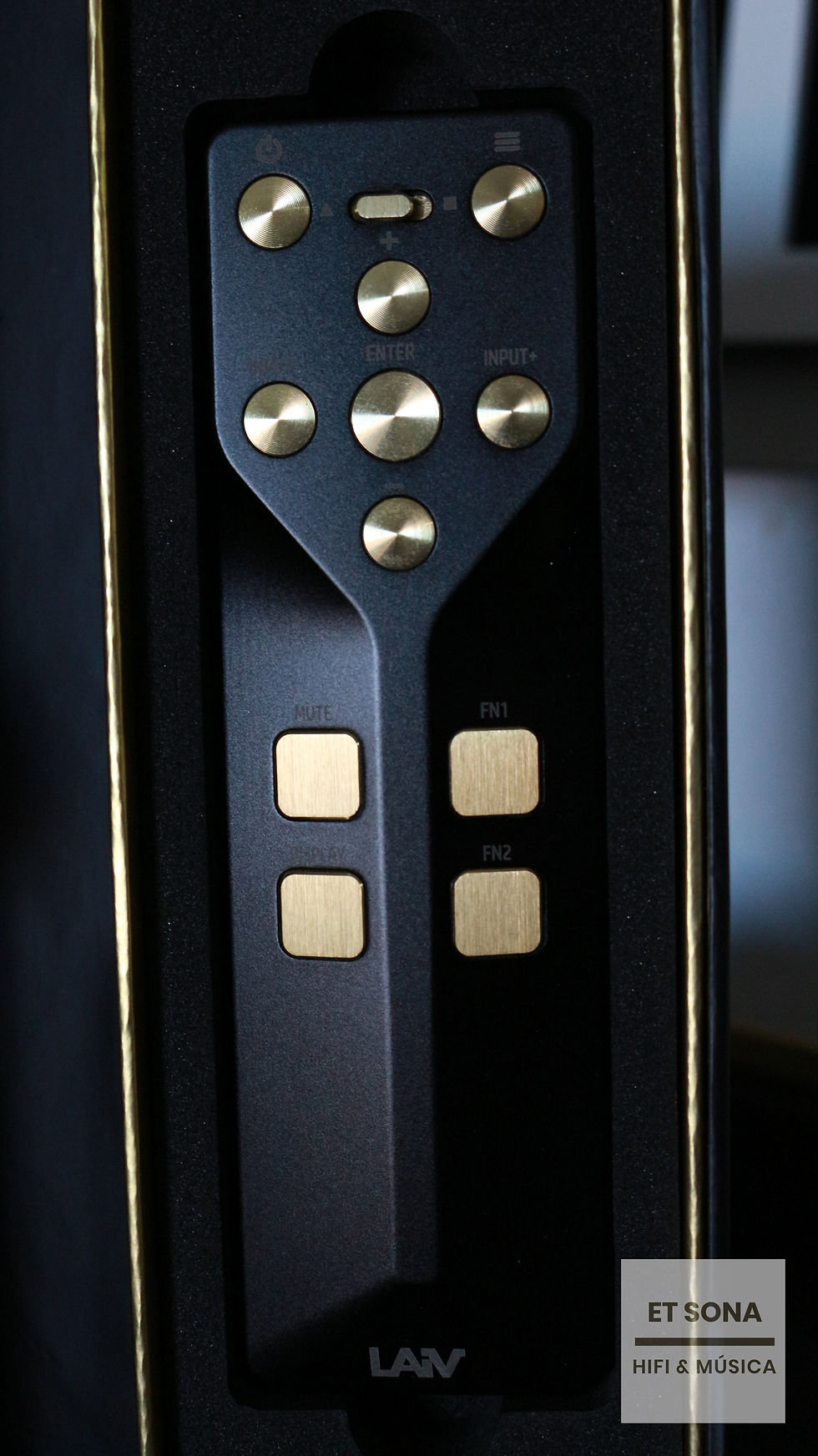
An added bonus is the remote control, also machined from anodized aluminum and featuring good weight and presence. It is a pity that its use has been merely anecdotal, as having the equipment so close made it unnecessary.
Operation of both devices is intuitive and allows for quick parameter adjustments. The combination of the menu button and the rotary knob on both (with a push-button option) takes a couple of uses to master, provides satisfying tactile feedback, and allows for pleasant interaction with the equipment.
How it sounds
The LAiV Harmony stack has stood out, in my experience, for a power delivery and authority that surprises from the very first note. The synergy between the DAC and the HP2A amplifier creates a sound signature that is transparent, fast, and possesses a control over the headphone driver that is almost surgical. Both the HD490 Pro Plus and the HD660S2, both from Sennheiser, are not particularly difficult to "drive," yet they are deeply transparent and appreciative of the power delivered to them. That said, I set out to listen:
Justice – "D.A.N.C.E." (†): Using a MacBook Pro as a source and streaming through ROON + Qobuz, this 2007 classic helps us evaluate layers and textures. The choir and vocals provide a very solid counterpoint to the beat and musical details. The LAiV set attacks the HD490 Pro Plus with great power, so much so that we cannot go much beyond -40dB, no matter how much we want to get carried away by the music. In the following track, "Newjack," the eclectic and almost choppy rhythm forces the HP2A to react quickly, and its control over the Sennheiser drivers is nothing short of impressive. Even at low volume, the power and authority with which it handles the headphones is surprising.
Kelly Lee Owens – "Olga" (LP.8): This is a track with cold and minimalist production, where silence and sub-bass rule. Here, the Harmony DAC demonstrates its ability to resolve micro-details in synthetic textures, while the HP2A maintains control of the bass with absolute firmness. The sense of space is enormous; Owens' voice appears suspended in an absolute vacuum, free from any background noise, evidencing an exceptional low-noise design. The transition between electronic pulses and silence is instantaneous, without a trace of artificial decay. I was particularly impressed by the absence of digital artifacts in the DAC, even with a "noisy" source like a computer. Moving to my dedicated streamer (a modified Raspberry Pi), I noticed even greater "air" and depth in the background.
Ólafur Arnalds – "Spiral" (Some Kind of Peace - Piano Reworks): To measure naturalness and timbre, we turn to this intimate piano accompanied by subtle strings. The resolution of the set allows one to hear the friction of the felts and the mechanics of the instrument with astounding clarity. The piano notes have real weight, a harmonic density that avoids excessive analytics to focus on emotion. The stereo image is very precise, placing each instrument with an accuracy that facilitates total immersion in the piece. The dimension added to the soundstage is also significant, as the set presents a full-sized piano, curiously housed within the space defined by the diameter of my head.

Technical Data
Architecture: Fully balanced design.
DAC: High-precision R-2R architecture (Harmony series).
Amplifier: HP2A with balanced XLR, balanced 4.4mm jack, and 6.35mm SE outputs.
Inputs (Amplifier): 1 pair of balanced XLR (expandable with LExt module).
Inputs (DAC): USB, S/PDIF, Toslink, I2S.
Finishes: Black and Silver.
Dimensions: Compact desktop design with aluminum chassis (255mm x 250mm x 75mm including body and feet).
For output power and other specifications, I refer you to the manufacturer's website; however, I do not believe you will lack the power to drive any headphones under any circumstances.
Conclusions
The LAiV Harmony units are confirmation that a young brand can look established giants in the eye if engineering and design go hand in hand. The control the HP2A exerts over headphones, combined with the cleanliness and resolution of the DAC, makes it one of the most solid desktop solutions to have passed through Et Sona.

Yes, the LAiV units are balanced, so the input to the amplifier is exclusively through these connections. There are two ways to adapt it to RCA connectors: the company itself offers LAiV XLR adapters, which convert between this connector and an RCA cable, or alternatively, you can acquire the LExt module. Both are undoubtedly good options if your setup requires it.
Available in black and silver, their aesthetics are as impeccable as their sound. With prices of €2,899.00 for the HP2A and €2,999.00 for the DAC, these devices place themselves in the high-end category on their own merits. You can find them through Supersonido, both on their website and at their locations in Bilbao and Barcelona. If you are looking for authority, transparency, and top-tier construction, the Harmony combo is a safe bet. Be aware that a sad but necessary price increase has been announced for the coming months, so this is an excellent time to acquire them.


Comments