

Raspberry Pi Streamer
- Fernando Alday

- Mar 24
- 10 min read
The world of Do It Yourself arrives at Et Sona and we propose a low-cost alternative to enter the world of Streaming through the front door.

An audio streamer for less than €100? Yes, it is possible. Join me on this journey through the small but rewarding adventure that has been entering the world of streamers based on SBC (Single Board Computers) technology or, for those of us born under the tongue of Cervantes, single-board computers.
The beginning. For the last year I have been using, thanks to Ignacio from Elektra Hi-End, an Innuos PULSE Mini as a streamer. The equipment, reviewed at the time in Et Sona, has demonstrated a great sound and an ease of use that guarantees that even those most reluctant to take the leap to streaming can do so without losing their minds in the almost infinite world of configurations and other computer adventures.
However, everything has to follow its cycle and, at some point, the Innuos will return to Elektra Hi-End. Now began the difficult task of looking for a replacement for a piece of equipment that, in principle, never did anything wrong. Why don't you keep the Innuos? Good question, excellent in fact. The price is accessible (by the standards of the hobby), the performance, great. But, the Innuos has been in the system for almost a year, and it is also a loaner unit. It's time to change. If reviews are always done with the same equipment, little change will be noted. On the other hand, there are many other options on the market that I have tried and many others that I would like to try.
The breakup has not been easy, but it is time to follow the path and take the next step. With this in mind, I had to sit down, notebook and pen in hand, a few espressos and with my thinking cap on. What do I want in a streamer? The list, for now, went more or less like this:
Reliability: In terms of connection, operating system, handling, etc. In other words, I don't want any headaches.
Flexibility: In the ideal world, a system easy to connect or integrate with other equipment, easy to move to be able to perform tests, etc.
Good sound: This explains itself; it is useless to have a streamer that is easy to use and with solid construction and software if the sound is not up to par.
Accessible price: Here I had a small problem. Price is subjective. 100 is not the same as 1,000 as 10,000 but it is also not the same for you or for me, nor for the neighbor or his cousin. The issue, it seems to me, goes more towards the theme of value or the famous quality/price ratio. With the Innuos, for example, it is clear to me that it is a positive balance. The cost of both units (let's remember that the PULSE mini is accompanied, in my case, by the LPSU) is positive.
That being said, I have paid no damn attention to the list, I have gone my own way as they say colloquially and, after having spent too much time in online high-fidelity forums, curiosity bit me: What if I get involved in making my own streamer? What's the worst that can happen?
The journey of discovery began with a couple of realizations. First, streamers are not, for the most part, audio components. Those that incorporate a DAC could be considered hybrids but, in itself, the component that performs the task of capturing information from the streaming service and taking it to the DAC (internal or not) is a computer component, more specifically, of network and processing.
Now then, what I require is a transport or pure streamer, since I already have an excellent DAC in my equipment (previously a Lampizator Amber 5) and now a Lampizator Atlantic 5 TRP. That said, my preliminary research oriented me toward those proposals from various audio houses that, by themselves, base their designs on the so-called SBCs (Pro-ject, Orchard Audio, among others). This led me to the second realization: companies put fences around their implementations. For example, Pro-ject has abandoned the previous generation streamers and it is not possible to update them. That said, since I don't like buying things only to have to throw them away (a lesson learned with an Apple TV that today doesn't even serve as a paperweight), another important point arose on my list of requirements: Open source or, what is the same, open code or, at least, a company that respects the right to repair and update its equipment by the user.
Evaluating the above, I have made a small diagram to orient my use case or, so to speak, my implementation model:
A Streamer in transport mode, that is, I do not require a DAC.
Open code or system or, failing that, one that allows updates/repairs.
Connection via USB (better performance, plus I have good USB cables for audio).
Now, to look for options. The most recommended by other users who have already traveled similar paths? A Raspberry Pi. I clarify. The equipment has not been ceded, lent, or gifted to me. What you will see in this post I have bought and paid for out of my own pocket, all as a small experiment and to help whoever might find these lines to follow a similar path avoiding the obstacles or pitfalls that I encounter. We continue.

The choice was simple, at the time of writing these lines, the Raspberry Pi 5 is the most recent model and with an accessible price. The shopping list went like this:
Raspberry Pi 5 4GB Ram - €69.95
5.2V 3A USB-C Power Supply with switch - €8.50
Kit of 2 heatsinks for Raspberry Pi 5 - €3.95
3007 PWM Fan - €2.95
Case for Raspberry Pi 5 - €4.95
Total: €90.30, including shipping costs: €94.25
Okay, I got a bit carried away, in reality, all we need is the Raspberry and the power supply but, hey... you have to put the thing somewhere, right? And the heat issue, that will have to be managed too. Things that also turned out to be necessary but, fortunately, I already had at home: A micro SD card. We don't count that one, but let's keep an eye on the list of expenses.
For the installation, I went a few steps ahead and placed the heat sinks, the fan and the case, connected the ethernet cable and the SD card. That done, we have to take the next step: The choice of the operating system that will manage the streaming issue. There are many options, free and paid. My choice, for simplicity, has been RoPieee. Not only that, the compatibility with ROON guarantees that I won't lose the service, benefits and environment that I enjoy so much. The choice depends on what you want to get from the software and, furthermore, there is no penalty for being wrong, it is as easy as installing the one we like again.
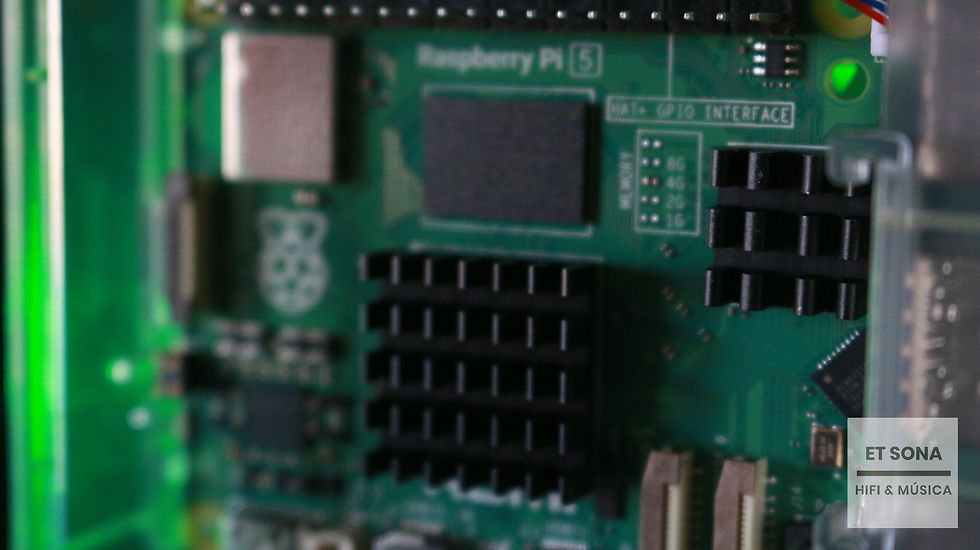
The installation process is simple, but requires certain computer knowledge. You must download the system, install it on the SD card and place it in the Raspberry. The installation is done with a program called "Etcher" and, what it does, is allow the SD to function as a boot or start disk. I wouldn't want to go into details so as not to deviate from the post but, believe me, nothing can go wrong, if you try it a couple of times, you will surely have it resolved.
Once the creation of the boot drive on the SD is finished, then we can place the card in the Raspberry and turn it on to verify that everything works. We must install the card, connect the power adapter and the ethernet cable. The easiest way to verify the operation is to see that the installation process is successfully achieved; this is achieved by connecting one of its HDMI outputs to a monitor. We will see text showing the processes and, at the end, the confirmation. Then we can access the RoPieee configurator (as if it were a web page) and verify that everything is in order.
Once configured, I went to ROON, connected the Raspberry to the DAC via USB and verified that it appeared in the audio devices, selecting it as the Audio output. Everything worked, the first time and without headaches. A marvel. In total, I must have invested 1 hour of my time, maximum 2.
How it sounds.
The system for the test, then, was the following:
Preamp: McIntosh C504
Amplifier: McIntosh MC502
Power treatment: Lampizator Silk
Power cables: Bazco Audio L1 (custom), Gutwire B-10
Interconnect cables: Final Touch Audio Thebe RCA
USB cable: Final Touch Audio Callisto
Network cable: BAZCO Audio L1 Ethernet
Streaming Platform: ROON/Qobuz
DAC: Lampizator Atlantic 5 TRP
Speakers: Axxess L1
Speaker Cables: Nordost Blue Heaven
Rack: Artesanía Audio Prestige 4
Accessories: Artesanía Audio Damper / Gutwire Ultimate Ground Cable
We begin. We launch ROON and access Qobuz, the first tests are performed with the generic playlist I usually use for "first impressions," we give it some time and configure, both in ROON and in RoPieee.
The results? Surprising. Not only do we have an End Point for Roon, we have a small and discreet streaming device that allows us all the functions of one that multiplies it in size and weight. The sound is more than correct, not noticing any type of distortion or excess in digital artifacts. The response is fast and we have no loss of connection or service.
Ennio Morricone - Once Upon a Time in America - Titles. A track with a very musical tone and small sonic nuances that give us the opportunity to appreciate dynamic range, as well as the interference of digital artifacts in the sound. The coloration is neutral, with the characteristics of the amplification equipment and speakers, noting no influence from the streamer in terms of dropouts, noise, or interference.
The texture of the voice that is subtly presented in the track is realistic and does not suffer from harshness or loss of information of any kind.
Subsequent tracks, with slight timbral flashes in the highest registers, present an image and brightness consistent with the naturalness of the instruments and their dimension, dispelling fears of interference or information loss.
Listening now to Thelonious Monk - Monk's Dream, the separation and definition of the channels finds us well-placed and gives us an enviable presentation. The distinction between the instruments and their locations appears clean and clear. The subtle background details paint a realistic and coherent atmosphere. Again, we miss some dimension in the recording, as well as depth, but it is an experience similar to entry-level streamers from more commercial brands. Nothing to fear or, much less, to worry about.
Finally, Bang - Lions, Christians. Good initial impact. The fidelity of the recording, somewhat debatable but well-preserved, is transmitted in an organic way with an almost analog touch (a performance that comes to us, undoubtedly, courtesy of the Lampizator Atlantic 5 TRP DAC). This, however, would not be possible if the small streamer we have assembled did not have good "communication" with it, which should dispel doubts about its integration with other systems of higher performance and cost. Remember that the goal of this undertaking is to create a "minimal" streamer in every sense (cost, sound interference), except in sound quality, which is our ultimate objective.
Returning to the track, Frank Ferrara's voice and Glicken's guitar are transmitted with power, good definition, and reach, enough to get our feet moving and slightly recall that Black Sabbath hint that characterizes this song.
From the start, I must say that the integration with the ROON and Qobuz environment is magnificent and, I must say, has not presented any compatibility problems or loss of connection, even after repeated power cycles which, of course, have been part of the tests.
In general, I did not notice substantial differences compared to the use of other streamers, at least in a contained and normal operation. It is true that the depth and tone of the silences, as well as the depth of the stage presentation, do not have the dimension found with higher-performance equipment (in terms of resource optimization and power treatment), but come on, this is to be expected. Not only is it not a piece of equipment built for a single purpose, but it is also evident that we could benefit from better power treatment and management. But let's not get ahead of ourselves.

However, the handling of the audio surprised me pleasantly, as I expected lower quality than what I received. In general, I have no complaints; we have a completely functional streamer for less than €100. I even have to say that, saving the ridiculous proportion regarding its dimension (compared to what we are used to), it doesn't seem entirely ugly to me. I have the slight problem that the weight of my USB cable makes it move a bit, but I have already solved it by adjusting the angle.
Conclusions.
I start with the obvious. This is not something for everyone. If you don't feel comfortable navigating basic elements of computing, it is best to seek help or, failing that, a solution that is already ready and works as plug & play, although my experience indicates that, more frequently, streamers require additional steps of configuration, installation of applications or other elements that are similar to these steps.

The issue of the "noise" of the fan. First, in normal conditions of use, I haven't heard it activate even once. The rack has good space and dimensions that allow natural ventilation of the equipment, so I haven't noticed its activation; on the other hand, I have tested it forcing its operation, and the noise is not excessive nor does it bother in the reproduction of music. If desired, it can be dispensed with, though ensure the equipment is well ventilated and, at least, use the heatsinks for greater safety.
Can you live with this as a streamer? Yes, without a doubt. This, of course, if we like the initial sound. I must say that the use of ROON here is paramount, as it allows fine adjustments to the sound that, normally, would not be possible and that improve the presentation and dynamics of the final result. I don't want to omit the fact that, clearly, the final result is strongly influenced by the use of the Lampizator DAC and that, in retrospect, the pairing seems even somewhat ridiculous given the difference in prices. Of course, let's think that we are buying a product "in the raw," that is, an element that, if it were in the hands of a manufacturer, would probably go through a process of component improvement, a custom operating system, improved power treatment, etc. And, then, it would increase both its performance and its final cost.
The important thing and what we should take away from this text is, in my opinion, the idea that it is possible to generate solutions made by oneself, that these exercises allow us a better understanding of how high-fidelity equipment (or in this case digital audio) works and that, of course, we can have a streamer with good benefits for little investment, perhaps even just as a way to enter the world of digital audio since, should we not like the result, the Raspberry Pi can be reused in a myriad of different functions, from a traditional computer to a gaming platform, etc.
On the other hand, the apparent distance between the sound the Raspberry produces and a high-performance streamer can be reduced even further, as there is a flourishing market for accessories and additions to improve its benefits. We will try to explore it in subsequent texts.
Gallery.


Comments