

Kiwi Ears Cadenza II

Evolution in Harmony: Why the Kiwi Ears Cadenza II Sets a New Standard for Dynamic Drivers

The evolution of a classic imposes a strong presence and reinforces the legacy of a brand that has arrived to make a powerful impact in the world of IEMs.
Having analyzed its predecessor (Kiwi Ears Cadenza Review), the time has come to meet the evolution of these earphones. Already accustomed to the good sound we have enjoyed from the brand, we do not expect a disappointment from the Cadenza II, but they do promise to surprise us with an innovative driver composite. This version has moved away from the Beryllium of the first edition and bets on PET and Titanium for a clear, detailed, and, above all, highly controlled sound. Let’s dive in.
Construction
Let's start with the presentation. True to the brand's style, the earphones, the cable, and a limited selection of tips are presented in a simple box. In this price range, this is more than sufficient because I, at least, prefer that the manufacturer's budget be allocated to the product itself, not the box.
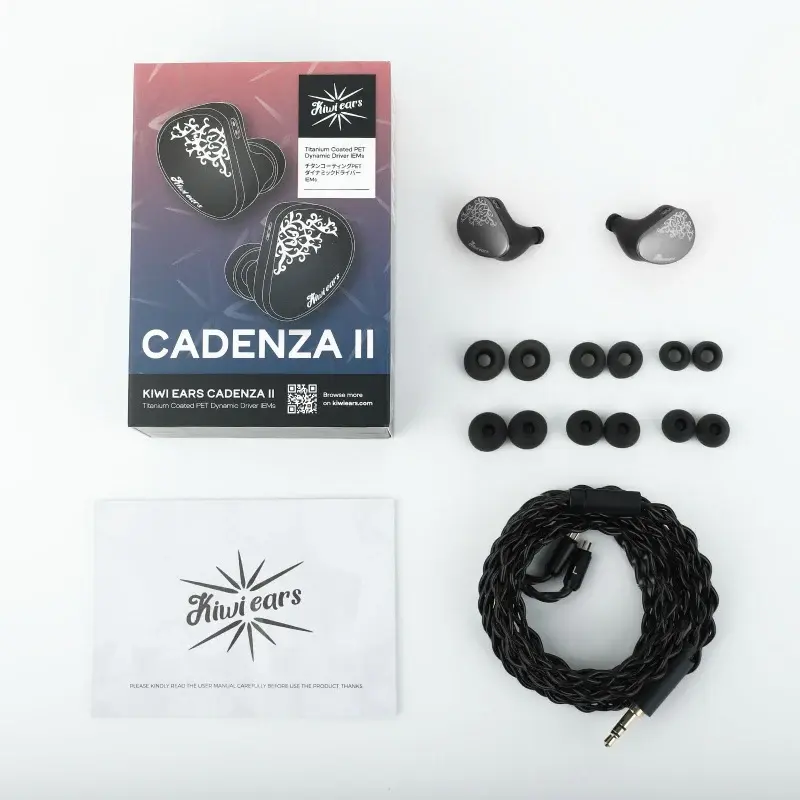
The Kiwi Ears Cadenza II relies on a unique dynamic architecture: its 10 mm driver with a PET diaphragm coated in titanium. This proposal combines structural simplicity with specific acoustic work through the KARS 2.0 system, focused on controlling internal resonances and stabilizing the transition between bass and mids. The approach is direct: tonal coherence, control, and versatility.
The capsule is made of polycarbonate composite resin with a soft touch finish. The CNC machined aluminum faceplate incorporates a laser engraved honeycomb pattern that provides structural rigidity and a differentiated aesthetic within its segment. It is available in 2 tones: gray and blue.
The cable is detachable via 0.78 mm 2 pin connectors and includes high purity monocrystalline copper conductors. The set is lightweight, ergonomic, and offers good passive isolation. The insertion is stable and allows for prolonged sessions without discomfort. Microphonics are contained and flexibility is sufficient. Kiwi Ears cables usually turn out to be of good quality.

Sound
The tonal profile sits on a balanced curve with a slight warm tilt in the bass and a controlled presence in the high zone; even so, detail is perceptible and pleasant. They do not result in auditory fatigue.
The bass presents good extension and density, with perceptible sub bass and a firm mid bass. The texture is correct and control clearly improves when the transducer receives sufficient current. With low output portable sources, the bass loses tension and the soundstage becomes compressed. Fed with more power, the driver gains authority and definition.

The mids maintain clarity and body. Vocals are perceived as well positioned, with clean articulation and no evident masking. The KARS 2.0 system contributes to a homogeneous transition between registers, maintaining tonal continuity and naturalness in acoustic instruments.
The treble is extended and offers good perception of detail. The high zone provides air and micro information without marked aggressiveness. The presentation retains structural smoothness, avoiding fatigue during long listens. The soundstage is wide laterally, with correct separation and stable positioning. Depth is moderate, though it improves with adequate amplification.
With Strange Little Girls by Tori Amos, Tori's voice and the recording details, especially in the opening track "New Age," are presented in a natural, coherent way and with a good transmission of presence and rhythm.
Moving on to some Jazz, Filin by Melissa Aldana presents us with a tonal complexity and very attractive rhythm that, after the first impression, is very pleasant through the Cadenza II. "Las Rosas no hablan" gives us a presentation predominantly rich in texture and timbre.
In general, I have enjoyed the Cadenza II with well produced music and, as I mentioned, better with good power behind them. Their clarity, projection, and timbre were extremely pleasant to me and did not produce fatigue.
Synergy and Amplification
Although the specifications suggest ease of use, the Cadenza II shows a more solid behavior when receiving higher current delivery. With basic sources they function correctly, but technical performance increases clearly with dedicated amplification. Thus, I found myself forced to move from the Apple Dongle DAC and the Blon V1 (the latter with better results) to the big guns.
With the iFi xDSD Gryphon, the bass acquires greater firmness, the stage expands, and micro detail is presented with better separation. The dynamic structure becomes more stable and the diaphragm control improves perceptibly. The result is a more open, defined sound with a greater sense of authority.
Specifications
10 mm dynamic driver with titanium coated PET diaphragm
Kiwi Acoustic Resonance System 2.0
Impedance: 18 Ω
Sensitivity: 106 dB
Frequency response: 10 Hz – 29 kHz
0.78 mm 2 pin connector
Monocrystalline copper cable

Conclusion
The Kiwi Ears Cadenza II offers a balanced tuning and solid construction within its price range. The driver's behavior improves evidently when receiving sufficient power, reaching a level of control and definition superior to what is expected in its category. With adequate amplification, the set shows tonal coherence, a good technical level, and a mature presentation.


Comments